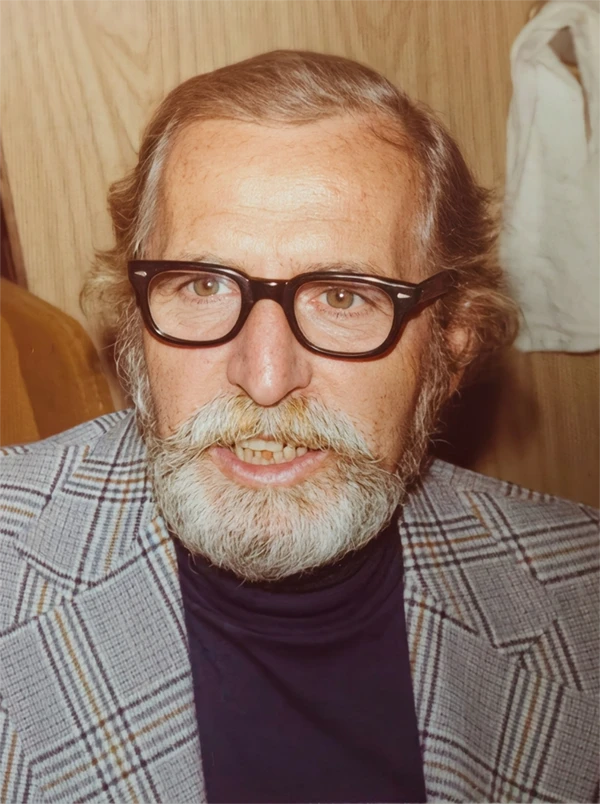
Robert J. Flood
Finding the extraordinary in ordinary lives
ROBERT J. FLOOD (1921–2001) wrote these five stories from the late 1970s through the early-1980s. It was one way of dealing with what was left inside him after fighting in WWII.
He'd joined the U.S. Army Air Corps shortly after Pearl Harbor. He'd hoped to be a pilot. He became a bombardier on a B-17, stationed in Bedford, England.
Bob was twenty-three years old when he was shot down over Germany on 29 March 1944. It had been his 25th mission, his last for that tour of duty. He would have left Europe a day or so later for home. Mind you, he had already volunteered for a second tour. He didn't want to miss the Invasion, which he and everybody knew was in the works.
Standing in the field alongside their crashed plane, Bob and his plane's pilot, Al Sheuring, watched the 8th Air Force — B-17s just like theirs — returning to England. They cursed their bad luck and then they took off running. They didn't get very far. Local German citizens captured them and were making plans to hang them for their "crimes." Fortunately, Luftwaffe personnel arrived, overruled the angry mob, and hauled Bob and Al away. They took them to an anti-aircraft warning station and later transferred them by truck to a Luftwaffe fighter base. Before Bob and Al were transferred, a German sergeant jammed his pistol in Bob's mouth and threatened to shoot him. Bob's offense was that he had told one of his plane's gunners to keep quiet. The German sergeant didn't like that. Al pushed the sergeant's gun away. The sergeant then turned on Al and was ready to fire. Another German sergeant intervened.
Later, at the same airbase, each American was placed in solitary confinement. Then they were taken out one at a time for interrogation by a German officer. Bob later said that officer looked like he came from Central Casting — stocky, bull-necked, and bald as a plate. He even wore a monocle and had a dueling scar. He had Bob beaten severely, not once but twice that day.
A day or so later, the Americans were transferred by civilian train from the airbase to Dulag Luft, a POW interrogation center near Oberursel, which is not far from Frankfurt. Somewhere along the way, Bob and Al got separated.
After a week, Bob and 40-50 POWs were loaded into small box cars. Each car was watched over by three armed guards. The POWs had one half of each car. The three German guards shared the other half. There was a layer of wet wood shavings on the floor but not enough room in their half of each box car for the Americans to stretch out to sleep.
Each day in each car, the Americans encroached a little on the guards' half of the car. After the third day, the guards relaxed and let the prisoners sleep wherever they could find a spot. Even so, it was an unpleasant trip. The Germans allotted black bread and one Red Cross parcel every day to every four or five prisoners. Sanitary facilities were non-existent. They were lucky if the train halted once a day for the men to relieve themselves.
The POW camp, Stalag Luft I, was near a military airfield and an antiaircraft training school. It was in a barren area on a small peninsula. Behind it were military buildings, heavy woods, and coastal defenses. About a hundred yards to the west was an inlet of the Baltic Sea that was about a hundred yards wide. Three kilometers further south was an important military airfield.
Bob was assigned to a room in "Block 12," the last in a row of blocks at the west end of the compound. While he was there, Allied prisoners housed in Block 12 created an ingenious series of underground escape tunnels that the Germans discovered and destroyed before anyone escaped. Bob did get out beyond the fences a couple of times, only to be greeted by armed German guards and hustled off to "The Cooler," a cold, brick solitary confinement structure. It was probably just as well. Even if a prisoner had escaped detection, there was no place to run, no place to hide. Nobody had successfully escaped in the history of the camp.
Bob remained at Stalag Luft 1 until the Russians liberated the base. Even then, it took an escape from the camp to connect with British troops and, ultimately, American command forces in order to finally get those prisoners from Stalag Luft 1 flown to France. Like most POWs, Bob returned to the states well after the rest of America's returning troops. No fanfare. No parades.
Bob is my father. He didn't talk much about his WWII experience when I was a kid. He would get annoyed, though, when we kids would watch Hogan's Heroes.
It took a while for him to make useful sense of what had happened to him. His understanding began to improve when he attended a reunion of his old flight group. After that, he became active in the WWII POW movement and the 8th Air Force Historical society.
After the war, Bob spent his professional life as a writer, creating both books and screenplays. The stories in A Nice Piece of Flying are rooted in Bob's real-life experience in WWII before, during, and after the war.
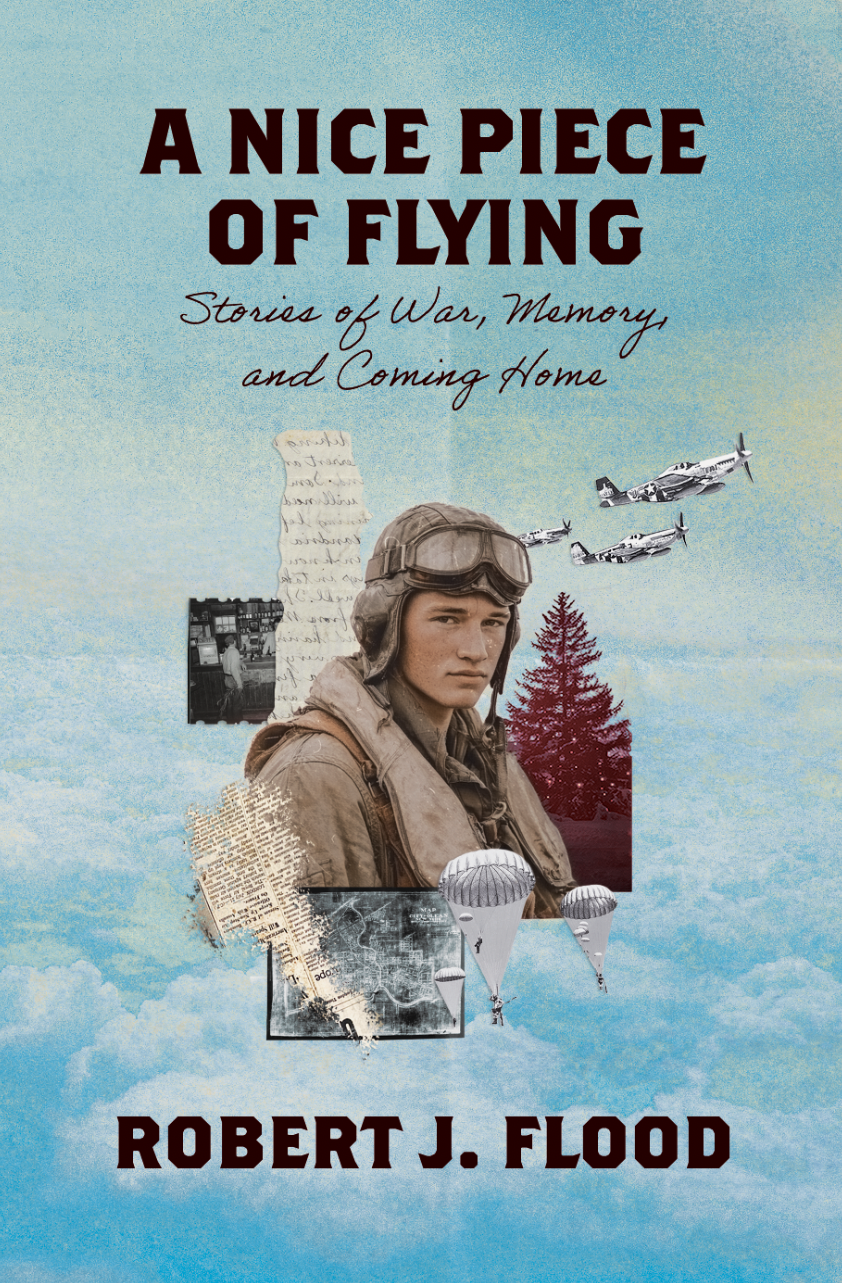
A Nice Piece of Flying
Stories of War, Memory, and Coming Home
In this powerful debut collection, Robert J. Flood draws from a lifetime of sharp observation and hard-won wisdom. These five stories traverse the landscapes of memory, family, and the search for meaning in ordinary moments. From the dust of Kansas to the quiet corners of suburban life, Flood writes with a plainspoken clarity that cuts straight to the heart of what it means to be human.